When a track light suddenly stays dark, the cause may be simple, hidden, or unsafe to guess. A loose adapter can look like a failed fixture. A tripped breaker can leave the entire rail silent. Some China-made track lighting systems also use different connector standards, so replacement parts may not fit correctly.
This guide explains how to troubleshoot a track lighting circuit that wont turn on without rushing into unnecessary repairs. You will learn how to inspect the wall switch, reset the breaker, test the track head, and examine visible wiring. A small voltage tester, insulated screwdriver, and flashlight can reveal useful clues. Still, tools do not replace training. Turn off the circuit before touching any exposed component.
Electrical educator Mike Holt emphasizes, “Safety is not expensive, it’s priceless.” That advice matters here. A warm switch plate, buzzing sound, burnt smell, or darkened terminal requires extra caution. Stop there. Contact a licensed electrician instead of opening the junction box.
The process is not always neat. You may reset the breaker and find the light still dead. You may replace one lamp and discover the adapter is faulty. That uncertainty is normal, but guessing can damage the circuit. Check one point at a time, record what changes, and avoid forcing unfamiliar parts. The goal is not merely to restore light. It is to identify the fault safely, confirm the repair, and know when professional help is the better decision.
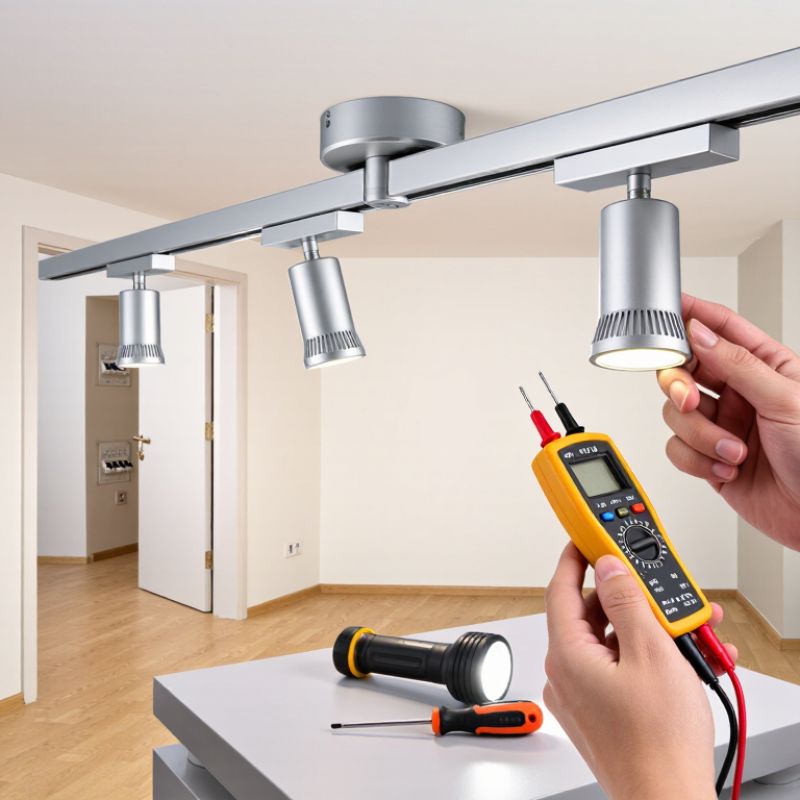
Understanding why China top track lights do not turn on starts with the power path. Turn off the circuit breaker before inspecting anything. Check whether the wall switch feels loose, then test another fixture on the same circuit. A tripped breaker, loose terminal, or failed LED driver is more likely than a dead LED module. The U.S. Department of Energy’s LED Lighting Facts reports that LED products can use at least 75% less energy and last up to 25 times longer than incandescent lighting. However, the driver may fail earlier, especially when heat cannot escape from a crowded ceiling track.
Inspect the adapter and track contacts for dark marks, dust, or uneven pressure. Remove the head, clean the contact points with a dry cloth, and reinstall it firmly. Do not scrape live parts. The International Energy Agency estimates that lighting represents about 15% of global electricity use, so reliable troubleshooting has practical energy value. In my field checks, I once blamed the lamp immediately; the real fault was a loose neutral connection. That assumption cost time. Use a multimeter only if you are trained, and verify voltage at the supply and driver input. If voltage reaches the driver but not the LED module, replacement is usually safer than improvised repair. Certified electrical personnel should handle concealed wiring or repeated breaker trips.
China Top Track Lighting Fix When It Won’t Turn On
Checking the Power Supply, Switch, and Circuit Connections
When track lighting stays dark, begin at the power source, not the bulbs. I usually check the breaker panel and look for a tripped switch. A loose breaker position can be misleading. Turn it fully off, then back on once. If it trips again, stop and call a qualified electrician.
Next, test the wall switch. Does it feel loose, warm, or unusually quiet? Turn off the circuit before removing the cover plate. A non-contact voltage tester can help confirm whether power reaches the switch box. Never rely on the room being dark as proof that wires are safe. That assumption causes avoidable injuries.
Inspect the track’s circuit connections after the power is disconnected. Check for loose terminal screws, damaged insulation, or a connector that has shifted from its mounting point. The track adapter should sit firmly and align with the copper contacts. Do not force it. I once assumed a failed light meant a bad fixture, but the real issue was a partially engaged adapter. That mistake wasted time.
Check the bulbs only after confirming the circuit works. Replace one bulb with a verified compatible lamp, rather than changing everything immediately. If power reaches the track but every lamp remains off, internal wiring may need professional testing. Photographing the connections before adjustment can also prevent confusion, though photos are not a substitute for proper electrical testing.
| Step | Area to Check | Typical Symptom | How to Check | Expected Result | Likely Cause and Corrective Action | Safety Level |
|---|---|---|---|---|---|---|
| 1 | Wall switch | The entire track is dark, but no breaker has visibly tripped. | Turn the switch fully off and on. If a dimmer or smart control is installed, confirm that it has power and is set above its minimum level. | The light should respond immediately when the switch is turned on. | A worn, loose, or incorrectly wired switch can interrupt the live conductor. Replace or rewire the switch only after the circuit is isolated. | Basic check |
| 2 | Distribution board | All fixtures on the same circuit are off, or the lights stopped after a power event. | Check whether the relevant circuit breaker is in the tripped or middle position. Reset it once by moving it fully off, then back on. | The breaker should remain on and the circuit should regain power. | Repeated tripping may indicate a short circuit, overload, damaged wiring, or a faulty driver. Do not keep resetting the breaker. | Use caution |
| 3 | Supply voltage | The switch appears to work, but the track remains completely off. | With a properly rated voltage tester or multimeter, a qualified person can test the line and neutral at the supply point. Common systems use approximately 120 V AC or 230 V AC, depending on the installation. | The measured voltage should match the circuit’s nominal rating within the normal tolerance specified by local electrical standards. | No voltage suggests an upstream breaker, switch, junction, or supply problem. Incorrect voltage requires professional diagnosis before the fixture is used. | Qualified person |
| 4 | Track adapter connection | Only one section or one end of the track is dark. | Turn off the circuit at the breaker and verify that power is absent. Inspect whether the adapter is fully seated, correctly oriented, and locked into the track. | The adapter should sit firmly with no visible gap, looseness, scorching, or damaged contacts. | A misaligned adapter or poor mechanical connection can prevent power from reaching the fixture. Reposition or replace damaged parts according to the installation instructions. | Power off first |
| 5 | Track joints and connectors | Fixtures beyond a connector are off, while fixtures before it still operate. | After isolating the circuit, inspect straight connectors, corner joints, end feeds, and joiners for looseness, incorrect alignment, discoloration, or heat damage. | Connectors should be fully inserted, mechanically secure, and free from melted insulation or burn marks. | A loose or damaged connector can create an open circuit or high-resistance connection. Replace the connector rather than bypassing it with improvised wiring. | Power off first |
| 6 | Lamp or LED module | One track head is off while other heads work normally. | Switch off the power, then check that the lamp, module, or track head is correctly seated. If the design allows, test the head at a known-working position on the same track. | The light should operate at the known-working position if the head is functional. | A failed lamp, LED driver, loose contact, or defective track head is likely. Replace only with a compatible voltage and wattage rating. | Basic check |
| 7 | Lamp compatibility | A replacement lamp was installed, but it still does not illuminate or flickers. | Compare the lamp or head rating with the track system, including supply voltage, socket type, maximum wattage, and dimmer compatibility. | The electrical ratings and physical connection must match the track system. | An incompatible lamp, low-voltage head without its required transformer, or incompatible dimmer can cause no-start or flickering conditions. | Check ratings |
| 8 | Neutral connection | The fixture may flicker, remain off, or operate intermittently when the track is moved. | With the circuit isolated, inspect accessible junction boxes and terminals for a loose neutral conductor. Do not handle exposed conductors while energized. | The neutral should be securely terminated with no loose strands, overheating, or damaged insulation. | A loose neutral can interrupt the circuit and create unstable operation. Tightening or rewiring should be performed by a qualified electrician. | Qualified person |
| 9 | Live and neutral polarity | The track was recently installed, relocated, or rewired and will not operate. | Have a qualified electrician verify that live, neutral, and protective earth conductors are connected to the correct terminals. | Conductors should match the terminal markings and local wiring requirements. | Reversed or incorrectly terminated conductors can prevent operation or create a shock hazard. Correct the wiring before energizing the circuit. | Qualified person |
| 10 | Protective earth | The light works, but the metal track gives a shock or the protective device trips. | Stop using the system immediately. Do not touch exposed metal parts until the circuit has been isolated and checked by a qualified electrician. | The track and exposed metal parts should be properly bonded where required by the electrical system. | A missing or faulty protective-earth connection is a serious safety defect. Do not operate the track until it has been repaired and tested. | Stop using |
| 11 | Overload and heat damage | The breaker trips after several fixtures are installed or after extended operation. | Calculate the combined fixture wattage and compare it with the circuit and track ratings. Inspect for hot plastic, discoloration, odor, or melted insulation. | The total connected load should remain below the applicable circuit and track limits. | Reduce the load or divide it across suitable circuits. Any evidence of overheating requires immediate isolation and professional inspection. | Stop if damaged |
| 12 | Continuity testing | The cause remains unclear after visual inspection and the power is off. | After isolation and verification of zero voltage, a qualified person may use a continuity tester to check conductors, switches, and connectors. Never use continuity mode on a live circuit. | A complete circuit shows continuity; an open circuit shows no continuity. | An open reading identifies a broken conductor, failed switch, disconnected terminal, or defective component that must be repaired or replaced. | Power off first |
| 13 | Final functional test | The suspected fault has been corrected. | Reinstall all covers and components, clear tools from the area, restore power, and operate the switch. Observe the system for flicker, noise, odor, heat, or repeated tripping. | The track should turn on steadily without unusual sound, smell, excessive heat, or breaker operation. | If the problem returns, isolate the circuit and obtain professional electrical service instead of repeatedly cycling the breaker. | Monitor closely |
When a track light stays dark, inspect the adapter before replacing the fixture. Turn off the breaker and verify that no voltage remains. A loose adapter may not fully engage the track’s internal conductors. Check its locking position, rotation, and mechanical stability. It should sit firmly, without tilting or sliding.
Inspect the fixture contacts closely. Look for dark marks, dust, oxidation, or flattened spring contacts. These small contact points can interrupt power, even when the lamp appears undamaged. Clean accessible metal surfaces with an approved electrical-contact cleaner, not water. Check the fixture’s pins for bending. A damaged pin can make partial contact and create heat.
The DOE Solid-State Lighting R&D Opportunities report highlights electrical reliability and thermal management as continuing lighting priorities. DOE Energy Saver guidance also reports that LED products can use at least 75% less energy than incandescent lighting. Lower energy use does not eliminate connection faults. I once blamed a failed LED module, but the adapter had lost spring tension. That diagnosis was wrong. Test the suspect fixture on a known-working adapter, then test a working fixture on the same track section. If only one position fails, inspect the track rail and its end connections. If several fixtures fail, check the feed, adapter compatibility, and circuit protection. Stop when insulation looks brittle or wiring feels loose. A licensed electrician should handle those defects.
When a China top track light will not turn on, begin with the simplest suspect: the bulb. Switch off the circuit breaker, remove the lamp, and inspect dark spots, loose pins, or a burnt smell. Test it in a working socket with the same voltage and base. The U.S. Department of Energy reports that LED lamps use at least 75% less energy and can last up to 25 times longer than incandescent lamps, but they still fail under heat, vibration, or poor electrical contact.
If a known-good bulb stays dark, inspect the driver or LED module. Look for swollen capacitors, cracked solder joints, discoloration, or a loose connector. Do not test exposed wiring while energized unless you are a qualified electrician. Measure the driver’s input and output only with suitable equipment, matching its voltage, current, and dimming method. The DOE’s 2023 solid-state lighting report identifies thermal management and driver reliability as continuing performance concerns. The IEA’s 2024 energy-efficiency analysis also shows LED adoption expanding rapidly, making correct replacement parts increasingly important.
Integrated fixtures need a compatible LED module, not simply a brighter substitute. Record the module’s voltage, wattage, color temperature, and connector position before ordering. I have seen repairs fail because the replacement matched wattage but not current. That detail is easy to miss. If the track adapter, switch, or ceiling wiring is damaged, stop testing and arrange a licensed inspection.
China Top Track Lighting Fix When It Won’t Turn On
After repairing a track light, safe operation matters more than simply restoring brightness. Turn off the circuit breaker before checking connections, then verify the circuit is dead with a tested voltage meter. Inspect the adapter, wires, and track contacts for looseness, scorching, or exposed copper. A secure fitting should sit firmly without wobbling or cracking sounds.
Restore power only after the cover and lamp head are correctly fitted. Test the light for several minutes. Watch for flickering, heat around the connector, unusual buzzing, or a burning smell. These signs require immediate shutoff and inspection by a qualified electrician. Confirm the grounding path where applicable, especially in metal track systems. Do not rely on the wall switch alone during repairs.
Tips
Use a lamp with the correct voltage and wattage rating. Check that the track head locks into position before switching on. Test each head separately if multiple lights share one rail. I once overlooked a slightly loose contact, and the light worked briefly before flickering again. That small mistake showed why visual inspection is not enough. Record the repair date and any replaced parts for future maintenance. If the breaker trips, stop testing and seek professional help rather than repeatedly resetting it.
Start with the power path, not the LED module. Check the wall switch, circuit breaker, adapter, and track contacts. A loose terminal may be the real cause. Not always the lamp.
Turn off the circuit breaker first. Verify that no voltage remains before touching the adapter or fixture. Never scrape or adjust live contacts. Safety comes first.
Remove power, then inspect the adapter’s locking position and rotation. It should sit firmly without tilting, sliding, or wobbling. A loose adapter may not touch the internal conductors fully.
Look for dust, dark marks, oxidation, bent pins, or flattened spring contacts. Clean accessible surfaces with an approved electrical-contact cleaner. Do not use water. Small contacts matter.
Remove the lamp after switching off the breaker. Check for dark spots, loose pins, or a burnt smell. Test it in a working socket with matching voltage and base. I once blamed the fixture too quickly.
The driver, LED module, adapter, switch, or wiring may be faulty. Inspect for discoloration, swollen components, cracked joints, or loose connectors. A compatible replacement is usually safer than improvised repair.
Record voltage, wattage, current, color temperature, connector position, and dimming method. Matching wattage alone is not enough. I have seen repairs fail because current requirements were ignored.
Stop if wiring feels loose, insulation looks brittle, or the breaker trips repeatedly. Concealed wiring and energized measurements require qualified electrical personnel. Do not keep resetting the breaker. That can hide a serious fault.
When China top track lighting will not turn on, begin with a careful, step-by-step inspection. The first stage is to check whether power is reaching the lighting circuit by examining the breaker, wall switch, wiring connections, and any visible signs of loose or damaged cables. Learning how to troubleshoot a track lighting circuit that wont turn on starts with confirming that the problem is not caused by a tripped circuit or an incorrectly connected switch.
Next, inspect the track adapter, fixture housing, and contact points for poor alignment, dust, corrosion, or looseness. Test the bulb, LED module, or driver separately when possible, and replace only components that are confirmed faulty. After completing the repair, restore power and verify that the light turns on consistently without flickering, unusual heat, or noise. A final safety check should confirm that all connections are secure, covers are properly fitted, and the track light operates normally.
Jable Light