Planning track lighting often looks simple: count the heads, add their wattages, and connect the rail. That approach can fail. LED fixtures may list input wattage, equivalent wattage, or driver consumption. These figures are not always interchangeable. Before choosing a transformer, dimmer, or circuit, confirm the actual input rating printed on every fixture or driver.
This guide explains how to calculate total wattage for a track lighting system using practical, repeatable steps. Start by identifying the number of track heads. Then record each fixture’s real wattage, rather than relying on brightness comparisons. A 10-watt LED head rated at 120 volts contributes 10 watts to the connected load. Six identical heads require 60 watts before considering system losses. Some low-voltage systems need an additional transformer allowance. Check its label carefully. A small detail can change the result.
Lighting designer Randall Whitehead has said, “Good lighting is not about the fixture; it’s about the effect.” Wattage still matters, but it is only one part of a reliable design. Beam angle, spacing, dimming compatibility, and heat management affect the final installation. In my experience, the arithmetic is rarely the hardest step. Finding accurate specifications is. Product pages can be incomplete, and replacement lamps may differ from the original load. Leave reasonable capacity for future changes, but do not guess. Verify the circuit rating and consult a qualified electrician when the system exceeds your experience. This article’s seven tips will help you calculate confidently, notice hidden loads, and avoid selecting equipment that is technically undersized.
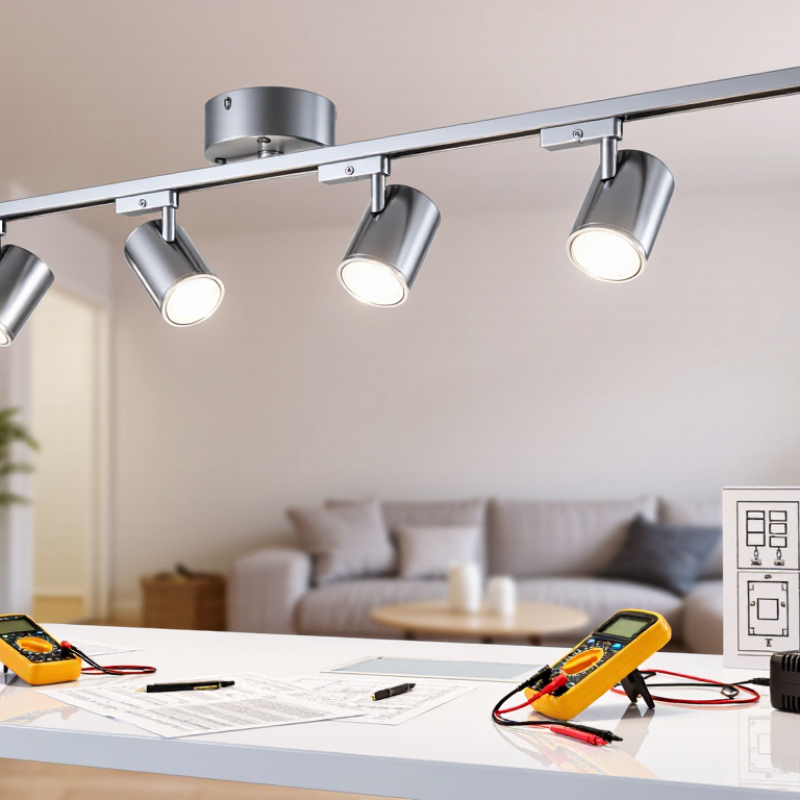
Before calculating total wattage, create a complete inventory of every track light. Walk along the entire rail and count each fixture, including small spotlights near corners. Record its location, fixture type, and wattage rating. Do not rely on appearance alone. Two similar lights may use different lamps. I once overlooked a compact accent light because it sat behind a display panel. That small mistake changed the final estimate.
Read the label on each fixture, lamp, or power adapter. Look for actual wattage, maximum rated wattage, voltage, and lamp quantity. An integrated LED fixture usually lists its operating wattage directly. A fixture with replaceable lamps may show only the maximum permitted wattage. Record both figures when necessary. Never confuse brightness with power consumption. A bright light can use less energy than an older, dimmer lamp.
Use this basic calculation: add the actual wattage of all installed lamps. If the actual figure is unavailable, use the permitted maximum for a cautious load estimate.
Write the information in a simple table or take clear photographs of each label. Check unreadable markings twice. This is where errors hide. Also inspect unused sockets and lights scheduled for installation. They may affect the final circuit load. My first inventory was incomplete because I counted only working fixtures. That approach seemed reasonable, but it ignored planned replacements. Recheck the list before selecting a compatible track system or calculating electrical capacity.
Multiply each fixture’s rated input watts by its quantity. Eight 12-watt fixtures require 96 watts. Use input wattage, not brightness ratings. Count every connected fixture.
Yes. Add the transformer’s input loss to the fixture wattage. A 100-watt transformer operating at 90% efficiency may draw about 111 watts. Check efficiency at the actual load. Underloading can increase losses.
Include drivers, dimmers, controls, connectors, and adapters. These parts may consume energy or create startup demands. The track usually adds little loss. Loose contacts can produce heat. Inspect them carefully.
Add fixture watts, transformer losses, and system losses. Then divide the total watts by circuit voltage. For example, 120 watts divided by 120 volts equals about one amp. Simple math. Recheck it.
Apply a practical reserve of about 10–20% for heat, aging, and future additions. Continuous lighting may require a 125% capacity calculation under local electrical rules. Six 12-watt fixtures and an 8-watt driver equal 80 watts. The design load becomes 100 watts.
Lighting operating for three hours or longer may be treated as continuous. Apply the required local capacity factor. At 120 volts, a 100-watt design load uses about 0.83 amps. Confirm the applicable rules.
Yes, especially when other outlets, fixtures, or equipment share the circuit. Do not treat the full breaker rating as available lighting capacity. Check the panel schedule and existing current. Startup inrush may trip a breaker. It happens.
Read every nameplate and measure input power with a suitable meter when possible. Confirm the transformer supports the calculated load continuously. Check conductor and breaker ratings. A spreadsheet can still miss field conditions. I once trusted fixture ratings alone. The measured load was higher.
Calculating the total wattage of a track lighting system begins with identifying every installed track light and checking its individual wattage rating. Add the wattage of all fixtures that may operate at the same time to determine the system’s basic lighting load. If the system uses a transformer, driver, or other control equipment, account for its energy consumption and normal operating losses as well. These elements can increase the actual power demand beyond the ratings shown on the lamps or fixtures.
When learning how to calculate total wattage for a track lighting system, it is also important to apply a reasonable safety margin, especially when the lights will run continuously for extended periods. Finally, compare the estimated total load with the circuit’s available capacity and confirm that the wiring, protective device, and power supply are suitable. This process helps support reliable performance, reduces the risk of overloading, and makes future lighting adjustments easier to plan.

 Jable Light