What Is the Difference Between IC and Non IC Rated Housing?

Time:2026-11-07 Author:Madeline
0%

What is the difference between IC rated and non IC rated housing? The answer affects more than the label on a recessed light. It can determine whether insulation may touch the housing, how heat escapes, and what installation details you need to check. Look into an attic, and you may find pink or white insulation packed around a ceiling fixture. That small detail matters.

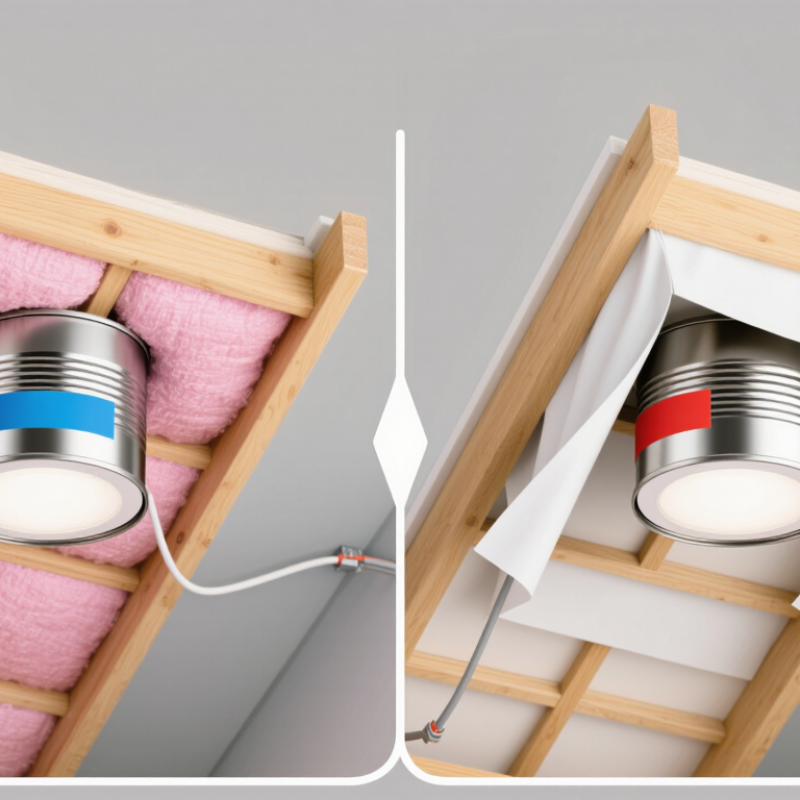
IC-rated housings are designed for installation in contact with insulation, when installed according to their instructions. Non-IC-rated housings generally require insulation to remain clear of the fixture. The required space varies by product, so do not guess or rely on a rule of thumb. Check the housing label and manufacturer’s instructions. Electrical educator Mike Holt’s safety-first guidance can be summarized, not quoted verbatim, this way: “Match the equipment rating to the conditions where it will be installed.” That is a useful principle, not a substitute for product documentation.

The distinction can be easy to miss. A finished ceiling may hide the housing, while an attic inspection reveals insulation touching its metal can. Some modern LED fixtures combine the light source and housing, which can make older assumptions unreliable. Check the exact model, its markings, and its installation requirements before replacing or covering a fixture. When the label is unreadable, pause. Confirm the rating with the manufacturer or a qualified electrician rather than assuming the fixture is safe for insulation contact. This guide explains the practical differences and the details worth verifying.
What Is the Difference Between IC and Non IC Rated Housing?

IC-Rated Housings: How UL 1598 Listing Allows Insulation Contact

An IC-rated recessed-light housing is designed and evaluated for direct contact with insulation under its listed installation conditions. UL 1598 covers luminaire safety, but a UL listing alone does not mean insulation may touch the housing. Read the label. Look for an explicit IC marking and follow the fixture’s instructions, including any limits on insulation type or installation. One detail is easy to miss: IC-rated does not automatically mean airtight, so check that separately if air leakage matters.

A non-IC housing generally needs the clearance specified by its manufacturer; covering it can trap heat around the fixture. Keep insulation back as instructed, even if the visible trim looks cool. Not the trim. The U.S. Department of Energy’s 2017 Energy Savings Forecast of Solid-State Lighting projected 348 terawatt-hours of annual savings in 2027 from wider LED adoption across general lighting. That projection describes lighting energy use, not housing safety. Still, efficient lamps do not replace correct thermal installation. I would verify the housing label before closing a ceiling, because the marking is easy to miss above a dusty joist.

Non-IC Housings: The NEC 410.116 Requirement for 3-Inch Clearance

For a non-IC recessed light, the three-inch rule matters where insulation is nearby. NEC 410.116 generally requires insulation to stay at least three inches from the luminaire’s enclosure, wiring compartment, and ballast, unless the fixture is identified for insulation contact. That space helps limit heat buildup around parts that can become hot during operation. A pile of attic insulation pushed against the housing is not a minor detail.

Measure from the housing, not from the visible trim at the ceiling. Keep insulation back on the sides and above the fixture, and check the installation instructions for any additional clearances. Short on room? Don’t compress insulation into the gap. That can reduce its performance and may create a hazard. An IC-rated fixture is designed and listed for contact with insulation, but its instructions still matter. Code editions and local requirements can vary, so verify the rules that apply to the specific installation. It’s easy to assume all recessed lights behave alike; they don’t.

IC vs. Non-IC Recessed Light Housings

Minimum clearance between the housing and thermal insulation

IC-rated housings are identified for direct contact with insulation. Non-IC housings require at least 3 inches of clearance from insulation under NEC 410.116. Always follow the luminaire’s listing, installation instructions, and applicable code edition.

Thermal Design: How Insulation Contact Affects Heat Dissipation

IC and non-IC ratings describe whether a recessed housing can safely contact insulation. The thermal difference is simple: insulation slows heat transfer away from the fixture. An IC-rated housing is tested for operation in insulation contact. A non-IC housing needs the clearance stated in its installation instructions.

ASHRAE Handbook—Fundamentals lists typical thermal conductivity near 0.04 W/(m·K) for fiberglass insulation, compared with roughly 200 W/(m·K) for aluminum. These figures show why insulation can restrict heat movement while a metal housing conducts heat readily. But conductivity alone does not predict fixture temperature. Housing shape, airflow, lamp power, and driver location matter too. That matters.

The U.S. Department of Energy’s LED Luminaire Lifetime: Recommendations for Testing and Reporting emphasizes measuring temperatures at critical LED components. A cool-looking trim is not proof that the LED or driver is cool. In a real ceiling, insulation may cover the housing unevenly, and airflow can be poor. That is where assumptions get shaky. Check the fixture’s rating and specified clearances, then install it as directed. An IC label helps, but it does not make every insulation depth or ceiling condition equivalent.

What Is the Difference Between IC and Non IC Rated Housing? - Thermal Design: How Insulation Contact Affects Heat Dissipation

Thermal Design Dimension IC-Rated Housing Non-IC-Rated Housing Practical Implication
Insulation contact Listed for installation in which insulation may contact the housing, subject to the product’s listing and installation instructions. Not listed for insulation contact; insulation must be kept away as specified by the product instructions and applicable code. Check the housing label and instructions before covering or placing insulation near a recessed fixture.
Heat-dissipation path Designed and evaluated to manage heat within the conditions of its rating, including permitted insulation contact. Typically relies on clearance around the housing to release heat into the surrounding air. Insulation around a non-IC housing can restrict airflow and cause heat to build up.
Thermal protection May include thermal protection or other design features, depending on the specific product. May also include thermal protection, but that does not make the housing suitable for insulation contact. A thermal cutoff is not a substitute for an IC rating or the required clearances.
Required clearance Insulation contact is permitted only where the listing and instructions allow it; other components or surfaces may still have limits. Must maintain the clearance stated on the fixture and in its instructions. Some products specify a 3-inch clearance, but requirements vary. Do not assume one clearance applies to every fixture; follow the specific product documentation and local requirements.
Effect of insulation coverage Can be covered by insulation only when installed as permitted by its listing; follow any restrictions on insulation type or placement. Must not be covered by insulation unless the product documentation explicitly permits it. Incorrect coverage can lead to overheating, nuisance shutdown, reduced component life, or a fire hazard.
LED heat management LED modules and drivers still generate heat; the fixture must keep them within their rated operating conditions. LED components also generate heat, and the required open space around the housing remains important. LED technology does not automatically make a recessed housing safe for insulation contact.
Typical application Useful where a recessed fixture is installed in an insulated ceiling or roof assembly, when the product is listed for that use. Suitable for locations where the specified clearance can be maintained and insulation will not contact the housing. Choose the rating to match the ceiling construction and the intended insulation layout.
Verification Look for an IC marking or explicit insulation-contact approval on the product label or documentation. Look for a non-IC marking or instructions specifying clearance from insulation and other materials. If the rating or clearance is unclear, consult the manufacturer’s instructions or a qualified electrician.

Important: Ratings and installation requirements vary by fixture. The product label, listing, installation instructions, and applicable local electrical code take precedence over general guidance.

Reading Fixture Labels: Identifying IC Rating and Maximum Lamp Wattage

Before choosing a lamp, read the label on the recessed-light housing, not just the trim. Look for “IC” or “IC-rated.” This indicates the housing is designed for direct contact with insulation, when installed as specified. A non-IC housing needs the clearance stated on its label or instructions. Insulation pushed too close can trap heat. Not a detail to guess.

The same label usually lists maximum lamp wattage. Treat this as the bulb’s actual wattage limit, not its “equivalent” brightness. A 10-watt LED may replace the light output of a much higher-wattage incandescent bulb, but its actual power use is still 10 watts. Check the lamp’s printed rating, and confirm it is approved for the fixture’s shape and operating conditions. Some labels are dusty, faded, or awkwardly placed; a phone photo and flashlight can help. If the rating remains unreadable, don’t assume. Find the housing documentation or ask a qualified electrician. It’s easy to focus on the bulb and overlook the housing label, and that small oversight can matter.

Choosing a Housing: Match the Rating to Insulation and Local Code

Choosing a housing means checking what surrounds it, not just how the trim looks. An IC-rated housing is designed for installation where insulation can contact its exterior, when its listing and instructions allow it. That matters in an insulated ceiling. Picture loose-fill insulation reaching the metal can above a bedroom. Check the label. A non-IC housing generally needs a specified clearance from insulation and other materials. Covering it can cause overheating and create a fire hazard. Details matter.

Before buying, compare the housing’s rating with the ceiling assembly and your local code. Requirements can vary by location, so confirm them with the local building department or a qualified electrician. Also follow the manufacturer’s installation instructions; a rating alone does not describe every clearance or installation condition. An IC rating does not automatically mean the housing is airtight, either. If the ceiling has insulation, limited access, or older wiring, guessing from appearance is risky. Measure the available space, inspect the product label, and verify the required clearance. Sometimes the simplest-looking option is not the right fit. That check is worth the extra minute.

FAQS

Can insulation touch an IC-rated housing?

Yes, when the housing’s label and instructions permit direct insulation contact. Check the exact installation conditions.

Does an IC rating mean the housing is airtight?

No. IC describes insulation-contact suitability, not airtightness. Check airtightness separately if ceiling air leakage matters.

What clearance does a non-IC housing need?

Follow the clearance stated on its label or instructions. Keep insulation back, even if the trim feels cool.

Where should I look for the IC rating?

Read the housing label, not just the visible trim. A flashlight can help above a dusty ceiling joist.

How do I check the maximum lamp wattage?

Use the lamp’s actual wattage, not its incandescent-equivalent brightness. A 10-watt LED is still a 10-watt lamp.

What if the housing label is hard to read?

Take a phone photo or find the housing documentation. Don’t guess; I might overlook a faded marking myself.

Does an IC rating replace local code checks?

No. Compare the housing with the ceiling assembly and confirm local requirements with a building department or qualified electrician.

Can an efficient LED lamp make an unsafe installation safe?

No. Efficient lamps do not replace correct clearances or installation instructions. Check the housing before closing the ceiling.

Conclusion

What is the difference between ic rated and non ic rated housing? An IC-rated housing is designed and tested for direct contact with building insulation, with its listing indicating that it can manage heat under those conditions. A non-IC-rated housing is not intended to be covered by insulation; NEC 410.116 generally requires at least 3 inches of clearance between the housing and insulation. The distinction matters because insulation can trap heat and affect a fixture’s safe operating temperature.

Thermal design, fixture labels, and installation conditions all help determine the right choice. Check the housing label for its IC rating and maximum lamp wattage, and follow the stated limits rather than assuming that similar-looking fixtures have the same rating. Choose a housing that suits the insulation around it, and confirm that the installation meets applicable local requirements.

Madeline

Madeline

Madeline is a dedicated marketing professional with a wealth of expertise in our company's core offerings. With a keen understanding of the industry, she brings a unique perspective to her role, consistently delivering high-quality content that highlights the superior aspects of our products. As......